Overview
Wheeled-biped robots combine the energy efficiency and speed of wheeled locomotion with the terrain adaptability of legged systems, making them ideal for applications like delivery, inspection, and rescue. However, existing control methods face critical limitations:
- Model-based approaches rely on simplified dynamics and non-holonomic constraints that restrict omnidirectional mobility and terrain adaptability, essentially reducing the robot to a “Segway with legs”
- Existing RL-based methods remain constrained to forward motion with explicit mode switching, lacking true omnidirectional mobility and adaptive hybrid locomotion
- The potential of the wheeled-biped structure for adaptive hybrid locomotion across diverse terrains remains largely unexploited
Status
We have trained a policy and evaluated it in both Isaac Lab and Mujoco simulators, demonstrating emergent gaits and adaptive hybrid locomotion. We are currently working on experiments and sim-to-real transfer. Our paper is under preparation for submission to IEEE RA-L.
Isaac Lab Evaluation
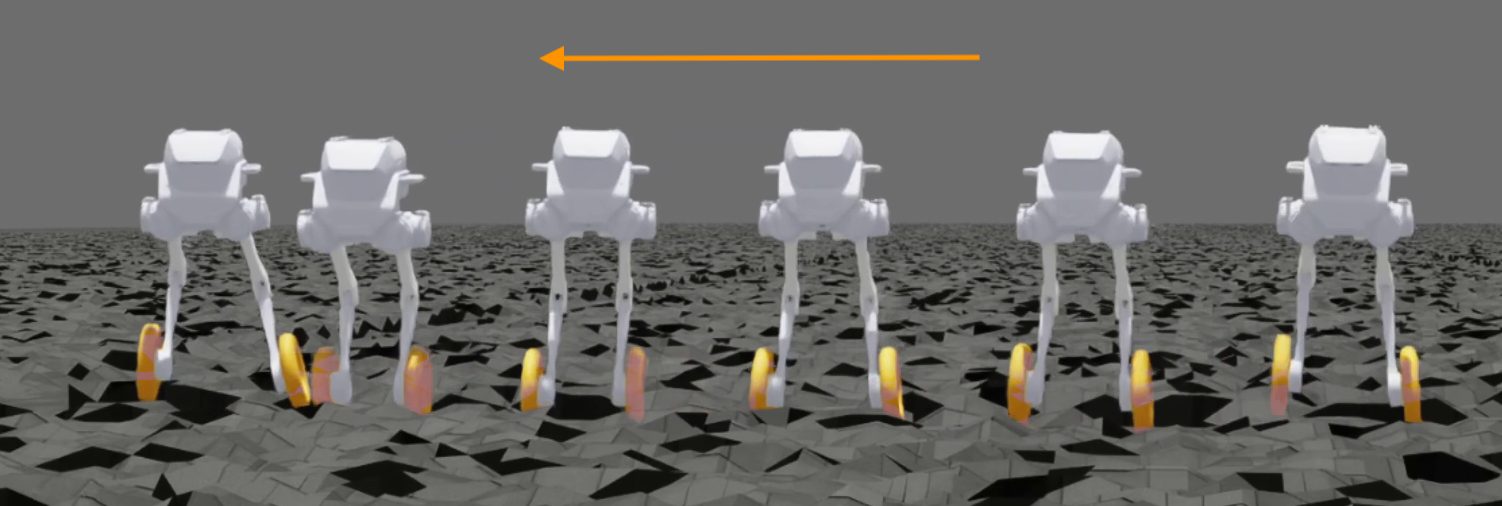
The trained policy exhibits emergent gaits, seamlessly transitioning between wheeled and legged locomotion based on demands.
Policy Evaluation in Isaac Lab
Sim-to-Sim in Mujoco
We have deployed the trained policy to Mujoco for further evaluation and simulation.
Policy Evaluation in Mujoco
Deployment onto Real Robot
We are trying to deploy the trained policy onto our real Tron1 robot. But we are still facing engineering problems in sim-to-real transfer. This video shows our initial attempt of deployment.
Initial Sim-to-Real Deployment Attempt